Thursday, August 18, 2011

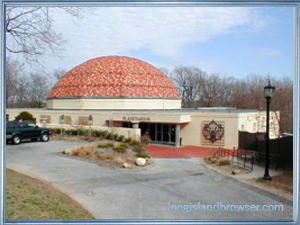
The Vanderbilt Museum Planetarium & The Astronomical Society of Long Island

Vanderbilt Museum Planetarium
180 Little Neck Road
Centerport, NY 11721
phone: 631-854-5555
www.vanderbiltmuseum.org


The Vanderbilt Planetarium opened in 1971 on the grounds of the Vanderbilt estate, and it is the largest facility of its kind on Long Island. The Planetarium's purpose is to provide visitors with information about the nighttime sky. The Planetarium's main feature is the domed, 60-foot Sky Theater. The theater's Goto star projector can display the sun, moon, stars and planets. It also recreates celestial events during our various Sky Shows.

The Astronomical Society of Long Island holds its monthly observing session at the Vanderbilt Planetarium. Their observing session is on the Wednesday evening closest to the New Moon. ASLI is one of the most active groups in the New York Metropolitan Area. We are a group of dedicated amateur astronomers and telescope makers with a passion for our hobby, and a willingness to share our knowledge and excitement of the hobby with others, both experienced, and those who may have just discovered the hobby.

MEETINGS:  EVERY Wednesday Night
MEETING TIME: 8:30 PM
LOCATION: The Vanderbilt Planetarium, Centerport, NY 
 
August 24 - The Science Museum of London - by Helen McEntireOur esteemed president went "across the pond" and while there visited the Science Museum of London.  She took lots of pictures which she will share with us in her talk.  She spent time in "The Exploring Space Gallery" which contains a host of rockets, satellites, space probes and landers.  She also visited the brand-new "Atmosphere" gallery - a fresh and exciting way to make sense of the climate - the science of how it works, what it's doing now, and what it might do next.

August 31 - Introduction to a Fantastic Discovery of the Radio Universe - Dr. Ron Milione, Senior Systems Engineer, DasNet Corporation, Bohemia, NY.  Radio waves were first detected from space in the 1930’s but few scientists took the discovery seriously.  After WWII scientists began to use Radar to investigate signals coming from space. Since that time Astronomical observations at radio wavelengths have played a key role in the discovery and study of certain classes of astronomical objects.  Dr. Milione will be giving us really interesting and thorough introduction to radio astronomy. 


Monday, August 8, 2011

Perseids Meteor Shower August 12th & 13th

The Perseid meteors were shed from the Comet Swift-Tuttle, at some point in the past, and appear to come from a point (called the radiant) in the constellation of Perseus. When they hit the atmosphere, they will be traveling at a fairly high rate of speed and often have long trails behind them.

Start watching for the Perseids in the first week of August. They will be building gradually to their peak. By the second week of August, the moon will begin interfering with the skies between midnight and dawn. On the mornings of August 12 and 13, you can still watch for some Perseid meteors to streak across the summer night from midnight until dawn.

Unfortunately, the full moon will spoil 2011′s Perseid display, obscuring all but the brighter meteors, during the shower’s actual peak. But you will see Perseids in the weeks leading up to the peak, too, if you have dark skies. These typically fast and bright meteors radiate from a point in the constellation Perseus the Hero. You don’t need to know Perseus to watch the shower because the meteors appear in all parts of the sky. 
 
The Perseids are considered by many people to be the year’s best shower, and often peak at 50 or more meteors per hour – in years when the moon is out of the sky. However, 2011 is not a great year for the Perseids, because the moon is full on the expected peak date. The Perseids tend to strengthen in number as late night deepens into midnight, and typically produce the most meteors in the wee hours before dawn. These meteors are often bright and frequently leave persistent trains.  

The Radiant of the Perseids Meteor Shower is from the Constellation Perseus in the Eastern Sky

Aditional Resources on the web


NASA: http://www.nasa.gov/topics/solarsystem/features/watchtheskies/index.html


Monday, August 1, 2011

An Original Science Music Video About Life In An Observatory!

Welcome to the Hotel Mauna Kea

Five planetary astronomers bring you an original science music video about life at the observatory at the 14,000-foot summit of Mauna Kea volcano in Hawaii. The astronomers, stationed at the Infra-Red Telescope Facility, wrote the song while they investigated aurora in Jupiter's atmosphere and the composition of Mars' atmosphere. One songwriter says: "The emission line and the dip that are mentioned in the video are real, and they are interesting. We have never abandoned an observing run to go to the beach."  

Juan Delgado (Flamenco guitar), Kelly Fast (vocal, videography, 12-string guitar), Ted Kostiuk (spoken vocal), Lyrics by John Annen, Juan Delgado, Kelly Fast, Ted Kostiuk and Tim Livengood.

Custer Observatory Hosts the Amateur Radio Club

Great South Bay Amateur Radio Club


Radio Waves and Physics
VLF Meteors, Lightning, Cosmic Rays

Helio Takai
Physics Department
Brookhaven National Laboratory
& Stony Brook University

Helio Takai


Saturday, July 23, 2011

New Suffolk Waterfront: Outreach Astronomy Program

At the Galley Ho in New Suffolk, NY, Steve Bellavia presented a power point on Astronomy to visitors and explored various topics in astronomy and astrophotography, Long Island’s current role in the field of Astronomy and the phenomenon of exploding stars (including photographs of the Supernova that occurred June 2nd in the Galaxy M51 - The Whirlpool Galaxy). Several telescopes were set up by David van Poppering, Steve Bellavia and David Barnett. David Barnett demonstrated his new Video Cam setup where everyone can see what the telescope sees in real time! Great job guys!


Osprey Pole & Catamarans
The Galley Ho


Steve Bellavia
David van Poppering
David Barnett's new Video Scope equipment mounted on his telescope

"Evening Under the Stars"

Tom Madigan hosted the second annual "Evening Under the Stars" at Patchogue's scenic Shorefront Park, overlooking Patchogue Bay. Although the weather did not cooperate Tom did a great presentation on the night sky. David Barnett, Steve Bellavia, Bill Crispino and Justine Haupt were on hand to talk about and/or demonstrate their telescopes to visitors and of course I was also there!


Tom Madigan

Dave Barnett & Steve Bellavia setting up telescope for visitors
Steve Bellavia & David Barnett


Steve Bellavia demonstrating his telescope to visitors

Friday, July 1, 2011

A Great Program was given by Jillian & Gordan: "GET OUT THERE AND LIVE!"

Jillian Dragutsky and Gordan Ostojic gave a great program at Custer Observatory on June 25th on how to enjoy life to the fullest. Their accomplishments and zest for life are amazing! 


GET OUT THERE AND LIVE!

 
Life is filled with opportunities to enjoy the wonders of our world.  This illustrated presentation will discuss some exciting ways to experience the beauty of our world.  The discussion will include scuba diving, rock climbing, caving, snow boarding, flying and many other adventurous activities.  The focus will be on how to get involved in each activity, the kind of gear that's needed, how to find experienced guides and teachers locally, and the types of experiences you can expect during your adventures.  Presented by:  Jillian Dragutsky and Gordan Ostojic, who have a passion for life and adventure, and seek ways to enjoy them both, which includes being active members of Custer and the Astronomical Society of Long Island (ASLI).